
The process of buying a house in Queensland comes down to eight steps: sort your finance, find the property, sign the contract, use your cooling-off period, inspect, go unconditional, pay transfer duty, then settle. If you’ve ever wondered what the process to buy a house in Queensland actually looks like in practice, this is it, laid out in the order you’ll face it.
The process of buying a house in Australia follows similar broad stages nationwide. Queensland adds its own rules around contracts, cooling-off, and disclosure, and that’s exactly where most first-time buyers get caught out.
Before you start the steps to buy a house, decide what you’re buying. A house and land package lets you pick a block and build to your own design. Off-the-plan means you buy before the property exists, which is common with units and townhouses. An established home is ready to move into the day you settle.
This choice matters more than it looks. It changes how your contract reads, how long settlement takes, and what “settlement day” even means later in the process.
Most Queensland homes, and almost every house and land sale, go through private treaty. You negotiate a price directly with the seller through their agent, and you sign a standard contract once you agree.
Auctions work differently. There’s no cooling-off period once the hammer falls, so your finance and inspections need to be sorted before you bid, not after. This guide focuses on private treaty buying, since that’s how most of our clients buy.
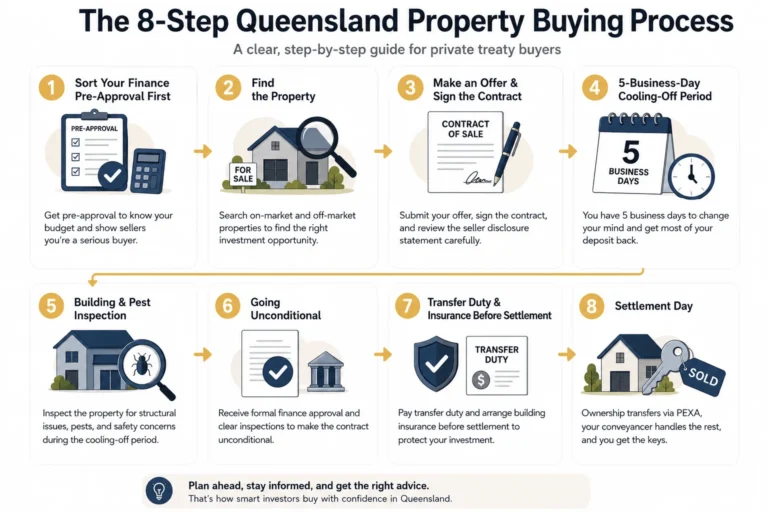
Talk to a mortgage broker or lender before you start inspecting properties, not after you’ve fallen in love with one. Pre-approval tells you what you can actually borrow, and it tells sellers you’re a serious buyer.
While you’re at it, check whether you qualify for the first home owner grant. We see buyers skip pre-approval all the time because they’re excited to start looking. It’s the single most common reason a good offer falls through later.
With finance sorted, the search starts properly. On-market properties are listed publicly through agents and portals, so you’re competing with everyone else who saw the same listing.
Off-market properties sell quietly, often before they’re advertised at all. Less competition usually means a better price, which is why this is worth exploring if you’re serious about investing rather than just browsing.
Once you find the right property, your agent submits a written offer on your behalf. If the seller accepts, you’ll sign a contract of sale, which is almost always the standard REIQ contract used across Queensland.
Here’s something that changed recently and catches a lot of buyers off guard: before you sign, the seller must now give you a Form 2 Seller Disclosure Statement under the Property Law Act 2023. It covers easements, encumbrances, and other facts about the property you’re legally entitled to see before you commit. Read it properly, or hand it to your conveyancer first.
Once the contract is signed by both parties, you get 5 business days to change your mind. The clock starts the day you receive the fully signed contract and runs until 5pm on the fifth business day.
If you pull out during this window, you’ll usually lose 0.25% of the purchase price as a penalty, but you keep the rest of your deposit. Keep in mind this protection disappears if you bought at auction.
Use part of your cooling-off period to book a building and pest inspection. A licensed inspector checks for structural problems, pests, and safety issues that a casual walkthrough simply won’t catch.
If the report turns up serious problems, you have options. You can negotiate repairs, ask for a price drop, or walk away while you’re still protected by the cooling-off period.
Once your lender confirms formal finance approval and your inspections come back clean, the contract becomes unconditional. Both sides are locked in at this point, and backing out gets expensive fast.
Don’t assume you’re unconditional just because your bank said yes informally. Wait for the written confirmation. That’s the version that actually counts.
Most people call this stamp duty, though Queensland’s official term is transfer duty. You’ll need to pay this before settlement, and first home buyers may qualify for a concession that reduces the bill.
It’s also the point to lock in building insurance, starting from the settlement day. You’re financially responsible for the property from that date, even if you haven’t moved a single box in yet.
Settlement is when ownership officially transfers to you. Your conveyancer handles the paperwork through PEXA, Australia’s digital settlement system, and you get the keys.
For an established home, this is simple: settlement happens, the property is yours, vacant and ready. For a house and land package, it’s split into two stages. You settle on the land first, then move through the build, with full handover only once construction reaches practical completion. This is the one part of the home-buying process that genuinely surprises new investors, so plan your cash flow for two stages, not one.
Eight steps, in this order: finance, find, sign, cool off, inspect, go unconditional, pay duty, settle. Whatever stage of the property buying process in Australia you’re at right now, getting Queensland’s specific rules right, especially the new seller disclosure requirements and the house and land settlement split, is what separates a smooth purchase from a stressful one.
If you’re weighing up a house and land package or want help finding off-market opportunities before they hit the public listings, our buyer’s agent team works through this exact process with clients across Brisbane and South East Queensland every week.
Welcome to Landmark Property Group QLD, Where Heritage Meets Luxury
White Rock Dr, White Rock QLD 4306, Australia
Sam@landmarkhomesqld.com.au
+61 499 207 377