
Buying an investment property is a big commitment. Before you sign anything, you want to know one thing: will this property cost you money each week, or make you money?
This investment property calculator gives you a fast, free estimate. Enter the purchase price, expected rental income, loan details, and holding costs. You'll get a weekly and annual cash flow estimate in under a minute, plus a full loan repayment breakdown.
It's built for Australian property investors, including first-time buyers looking at house and land packages across South East Queensland.
Your estimate
Property Investment Calculator
Estimate cash flow from rent, repayments, vacancy, and holding costs.
Step 1 of 4
Four simple inputs
How the calculator works
You'll answer four short questions. The calculator does the heavy lifting, then shows where the money goes.
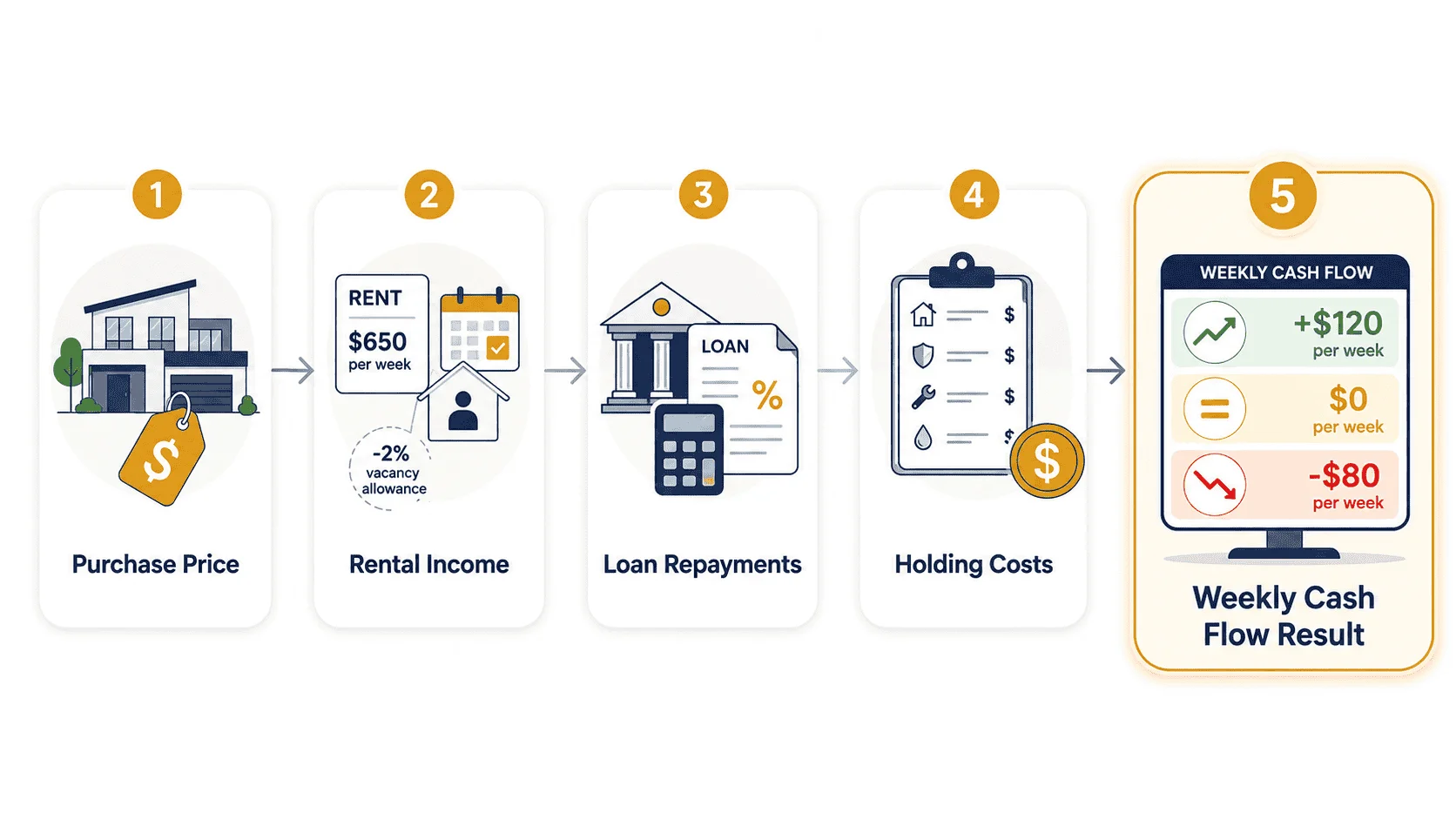
- 01
Purchase price
What's the property's purchase price?
- 02
Rental income
What weekly rent do you expect, and how many weeks of vacancy should you allow for?
- 03
Loan repayments
Use our built-in loan repayment calculator, or enter your own bank-quoted figure.
- 04
Holding costs
What are your estimated annual holding costs?
The loan calculator does the heavy lifting
Enter your loan amount, interest rate, and term, and it works out your repayment automatically. You don't need to already know that number. Choose principal and interest or interest-only, and pick weekly, fortnightly, or monthly repayments.
Once you hit calculate, you'll see your estimated cash flow, a full breakdown of where the money goes, and a year-by-year repayment chart and table.
Read the result
Understanding your cash flow results
Cash flow is what's left after rental income covers your loan repayments and holding costs. It's the single number that tells you whether an investment property will support itself or drain your bank account.
What is positive cash flow?
Positive cash flow means the rent covers your loan repayments and running costs, with money left over. The property pays for itself and puts cash in your pocket each week.
A positive result doesn't mean skip the due diligence. Still check the property's condition, the local vacancy rate, and the growth potential of the area before you commit.
What is negative cash flow?
Negative cash flow means the property costs more to hold than it earns in rent. You'll need to cover the gap from your own income.
Some investors accept negative cash flow for long-term capital growth. That's a valid strategy, but it only works if you can comfortably absorb the shortfall for years, not months.
What is neutral cash flow?
Neutral cash flow sits close to breakeven. Rental income roughly matches your costs. A small change in rent, interest rates, or vacancy could tip the property either way, so it's worth stress-testing the numbers before you decide.
Inside the estimate
What's included in your estimate
Expected rental income
You enter the property's expected weekly rent. The calculator also applies a vacancy allowance, because no rental property is tenanted 52 weeks a year. We default to two weeks, a reasonable middle ground for most areas, but you can adjust it based on the local vacancy rate.
Loan repayments explained
Your loan repayment is usually the biggest cost in the equation, so the calculator handles it properly.
Choose principal and interest if you want to pay down the loan over time. Choose interest-only if you want lower repayments in the short term, with principal repayments starting later. If you go interest-only, the calculator shows you what your repayment jumps to once that period ends, so there are no surprises.
After you calculate your result, scroll down to the repayment breakdown. You'll see a year-by-year chart showing how much of each payment goes to interest versus principal, plus a full repayment schedule if you want the detail.
Investment property holding costs
Holding costs are the ongoing expenses of owning the property, separate from the loan. Think council rates, water rates, landlord insurance, property management fees, maintenance, and body corporate fees if it applies.
You can enter one total figure, or break it down line by line if you already have quotes. Either way, these costs matter. A property can look cash flow positive on rent and loan repayments alone, then turn negative once you add realistic holding costs.
Decide with confidence
Why use this calculator before you buy
Buying decisions are easier with real numbers in front of you, not guesses.
This calculator lets you test a few different scenarios for the same property. What happens if the interest rate rises half a percent, or the rent comes in lower than the agent's estimate? Running the numbers before you buy means fewer surprises after settlement, not more.
It's also a useful gut check on affordability. If a property looks negative even with optimistic assumptions, that's worth knowing before you make an offer, not after.