If you’ve spoken with any leading agent or builder in Queensland today, you’ve probably heard “dual occ,” “duplex,” “dual key,” “granny flat,” and “townhouse” used almost interchangeably. They aren’t synonymous, and knowing the difference is your biggest advantage. Each one comes with its own title structure, council approval pathway, and investment outcome, so getting the terminology right can save you a costly mistake before you buy or build in Queensland.
This resource breaks down dual occupancy vs duplex, plus how dual key, secondary dwellings, and townhouses fit into the picture, so you can walk into your next conversation with an agent or builder knowing exactly what you’re comparing.
| Property Type | Titles | Typical Layout | Council Approval | Rental Potential |
|---|---|---|---|---|
| Duplex | Usually one title initially; can often be subdivided into two Torrens or strata titles | Two attached, mirror-image dwellings sharing a party wall | Material Change of Use (dual occupancy category) | Two separate rental incomes |
| Dual Occupancy | Typically one title (attached or detached) | Two dwellings on one lot | Material Change of Use, code or impact assessable | Two separate rental incomes |
| Dual Key | One title, one legal dwelling | One structure, two self-contained living areas, single entry | Usually assessed as a single dwelling | One rental listing, two income streams |
| Secondary Dwelling (Granny Flat) |
Same title as the main house | Smaller, subordinate unit on the same lot | Often accepted development, subject to size limits | Can now be rented to anyone on the open market |
| Townhouse | Individually titled (community title) | Typically three or more attached dwellings | Material Change of Use, usually impact assessable | One rental income per title |
Not sure which property type suits your goals? Speak with the Landmark Property Group team QLD. We help buyers across Brisbane, Logan, and Ipswich find the right fit.
Dual occupancy is the umbrella term for two separate dwellings on one lot of land. Under most Queensland planning schemes, these properties remain on a single title unless the owner actively subdivides them.
Because this category is so broad, it technically covers a duplex, a dual key home, and various secondary dwelling arrangements. This overlap is exactly why the terms confuse people. (For a full breakdown in detail, read our guide on what a duplex home is alongside this comparison).
Crucially, this setup isn’t just for established homes. Many buyers secure a house and land package, select a specific dual occupancy design, and build it from the ground up on a fresh block.
This comparison is exactly what most buyers search for. We have a straightforward answer: a duplex is simply one specific type of dual occupancy. However, not every dual occupancy qualifies as a duplex.
A true duplex always features two attached dwellings. Builders construct them as exact mirror images of each other. A single shared party wall connects both units.
In contrast, a broader dual occupancy setup gives you more freedom. You can build attached or detached structures, and the two separate dwellings do not need to look identical.
A duplex generally starts on one title. However, if the block and zoning allow it, an owner can subdivide the finished duplex into two separate Torrens titles or strata titles. This option means you can sell each half independently. The process involves lodging survey plans. Once the council approves them, you receive a subdivision certificate to register the new titles. In contrast, a standard dual occupancy does not automatically offer this flexibility. Your subdivision potential depends heavily on lot size, frontage, and the local planning scheme.
Because a duplex shares a party wall and a single roofline, the two dwellings form one structure from day one. A detached dual occupancy is entirely different. It might feature a second dwelling at the back of the block or a completely separate house. There is no shared wall at all.
Approval differences dictate your project timeline. In Brisbane, the Brisbane City Council assesses dual occupancy development via a Material Change of Use application. Your specific zone determines the assessment. For example, a block in a Low-Medium Density Residential zone supports a dual occupancy much better than lower-density housing.
An analysis of Brisbane City Council application records by Casa Intelligence provides crucial information. They found council approved over 90% of applications, with a median turnaround of 113 days. However, that clock restarts if the council requests more details.
If your goal involves a 1-into-2 lot split, budget carefully for this step. A standard split in Brisbane costs between $45,000 and $70,000. These council approval fees cover surveying, town planning, and new utility connections.
Here is a distinction many QLD buyers get wrong. The rules changed recently, creating new opportunities. A secondary dwelling (what most people call a granny flat) is a smaller unit. Builders construct it on the same lot and same title as the main house. It features its own kitchen, bathroom, and living area. However, it remains subordinate to the primary dwelling.
For years, only family members or relatives could occupy granny flats in Queensland. That changed when the Queensland Government planning department issued an amendment to the Planning Regulation. This legislation took effect on 26 September 2022. It removed old restrictions across every council area in the state. In practice, homeowners can now lease a granny flat to any tenant on the open rental market, provided they meet all council and building requirements.
If both setups generate rental income, what separates them? Two things matter most: scale and title.
Scale: A true dual occupancy provides two comparably sized dwellings. A secondary dwelling is deliberately smaller. Most councils cap it at 60 to 80 square metres, depending on the local planning scheme.
Title: In many cases, you have the ability to subdivide a dual occupancy into two separate titles. A secondary dwelling permanently shares one title with the main house.
Take a standard house-and-land block in Logan as an Example. You build a granny flat out the back. You keep one set of council rates, stay on one title, and enjoy a lower overall build cost.
On the other hand, building a full dual occupancy on the same block means two comparable homes. You face higher construction costs, but you gain the option to subdivide and sell each side down the track. It is the exact same land, but a completely different investment strategy.
A dual key is the pairing that trips up even experienced investors. Under planning law, a dual key property is classified as just one single dwelling, even though it functions like two separate homes.
The layout features one shared entry point. This opens into two separate, self-contained living areas, each complete with its own kitchenette, bathroom, and lockable door. However, you purchase, own, and eventually sell it as a single property under one title.
This setup matters most when securing finance. Because these homes are still relatively new to the Australian market, a lender will often treat them cautiously compared to a standard house or a true dual occupancy.
Quantity surveying firm Duo Tax notes that Australian lenders apply stricter requirements to these properties than to standard homes. They often demand a larger deposit because overall demand for this property type is limited.
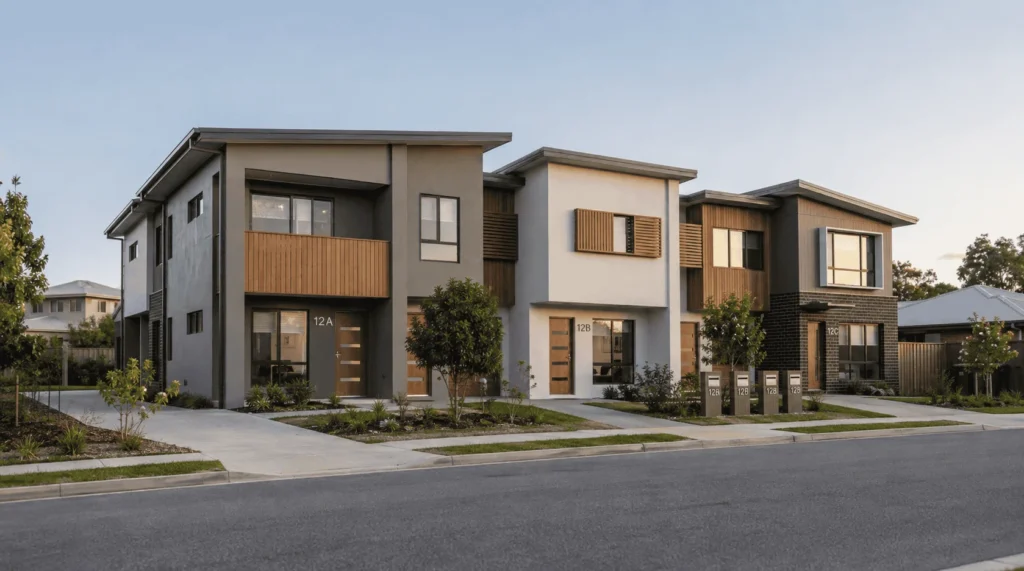
A townhouse is usually part of a larger group. It typically features three or more attached dwellings. A community titles scheme gives each dwelling its own individual title.
Unlike a duplex or a standard dual occupancy, a townhouse almost always requires a body corporate. Shared property like driveways, fences, and sometimes gardens demands collective management.
This body corporate involvement completely changes your financial strategy. Buying a townhouse means you must budget for ongoing levies on top of your standard mortgage and council rates.
You split these fees between two areas:
An administrative fund: Covers day-to-day operations.
A sinking fund: Covers larger repairs down the track.
In South East Queensland, new townhouse developments typically charge fees of around $4,000 to $7,200 annually. This cost varies based on shared facilities and the overall size of the scheme.
By comparison, a duplex or dual occupancy avoids these fees entirely. The only exception is if the owner deliberately subdivides the property into a community title arrangement.
For an investor, this creates a clear choice. A townhouse offers predictable but permanent holding costs through continuous levies. A dual occupancy or duplex, on the other hand, escapes these ongoing fees altogether but forces you to handle the entirety of the maintenance yourself.
| Property Type | Typical Build Cost Indication | Approval-Related Costs | Ongoing Costs |
|---|---|---|---|
| Duplex | Two full dwellings, priced similarly to two standard houses | MCU application fee + subdivision cost if splitting titles (~$45,000–$70,000 in Brisbane) | Standard council rates, no body corporate unless subdivided into community title |
| Dual Occupancy | Comparable to a duplex, varies with attached vs detached design | MCU application fee, points-based per Brisbane City Council's fee schedule | Standard council rates |
| Dual Key | Similar to a single large house, plus fit-out for two kitchens/bathrooms | Building approval as a single dwelling | Standard council rates, one rate notice |
| Secondary Dwelling (Granny Flat) |
Roughly $130,000 to $250,000 for a self-contained granny flat, depending on size and finish | Often accepted development — no formal DA required if size and setback rules are met | Minimal — added to existing rates |
| Townhouse | Priced per individual title within the development | Developer-borne MCU costs (buyer typically purchases post-approval) | Body corporate levies (~$4,000–$7,200/yr) + council rates |
Figures above are general indications only and will vary by block, design, and council. Always confirm current costs with your builder, town planner, or council before budgeting a project.
Every property type follows a different council approval pathway. Understanding these rules is crucial before committing to a design, whether you are buying an established property or purchasing off-the-plan.
Here is how the council processes compare:
Duplex & Dual Occupancy: In Brisbane, these require a Material Change of Use application. The Brisbane City Council dictates that once planning is approved, a licensed certifier must grant separate building approval. Your zoning determines if this is code assessable (fast, no public notification) or impact assessable (slower, requires notification).
Dual Key: These typically require standard building approval as a single dwelling, bypassing the complex Material Change of Use process.
Secondary Dwellings: These benefit from Queensland’s most streamlined pathway. Under Queensland Government guidelines, many qualify as “accepted development,” meaning you skip a formal Development Application entirely if you meet size and setback rules.
Townhouses: Due to their scale, these almost always require a full Material Change of Use application and frequently trigger impact assessment.
Beyond the paperwork, councils rigorously evaluate physical site rules. Before approving any dwelling, they assess:
A tight frontage or steep slope can ruin a project, even with the correct zoning. Always secure a site assessment before you fall in love with a floor plan.
There’s no single “best” option here. It depends on what you’re trying to achieve.
Choosing between a duplex, dual occupancy, dual key, secondary dwelling, or townhouse comes down to your budget, titling preferences, and long-term investment strategy. With 15 years of experience across the Brisbane, Logan, and Ipswich markets, Sam Gadhiya and the Landmark Property Group team focus on matching the right structure to your block, not just selling you a floor plan. Stop guessing which property type will deliver the best return for your specific situation. Contact Landmark Property Group QLD today to discuss your site, review local market trends, and secure the right investment for your future.
Not quite. If an agent shows you a dual-occupancy listing, expect anything from two attached mirror-image homes to two completely separate houses on one lot. If they specifically call it a duplex, you can expect the attached, shared-wall version every time.
Only if it’s been subdivided into separate titles, until that happens, you sell both dwellings together as one property.
By definition, a dual occupancy has exactly two dwellings on one lot. More than two dwellings typically falls under multi-unit or townhouse development rules instead.
One. Despite having two separate living areas, planning law classifies and titles a dual key property as a single dwelling. When you compare dual key vs dual occupancy, that’s the main distinction: a dual occupancy is truly two dwellings that can often be subdivided, while a dual key stays one dwelling on one title permanently.
It depends on the block. A duplex offers a clearer path to subdividing and selling separately later, while a detached dual occupancy can suit blocks where an attached, mirror-image design isn’t practical. Both can generate two rental incomes.
Welcome to Landmark Property Group QLD, Where Heritage Meets Luxury
White Rock Dr, White Rock QLD 4306, Australia
Sam@landmarkhomesqld.com.au
+61 499 207 377