How do house and land packages work in Queensland? You buy vacant land and a new home built together, but through two separate contracts. That structure matters more than most buyers realise.
You sign the land contract first, then settle once the land titles are registered. The building contract comes after, once your floor plan and selections are locked in. Because the home doesn’t exist at the time of purchase, you pay stamp duty on the land value only, not the full package price. For first home buyers in QLD, that saving got even bigger after the May 2025 transfer duty exemption came into effect.
This resource walks through both contracts, the construction stages, what’s included in a fixed price package, how finance works, and what the 2025 stamp duty changes mean for your actual budget.
A house and land package combines a block of land in a new estate with a home design from a builder. You’re not buying a finished house. You’re buying the right to build one, on land chosen for that purpose.
Developers release land in stages within master-planned communities. Builders then offer floor plans suited to those blocks. Pick a block, pick a design, and the package brings both together in one process.
This differs from buying an existing house, where a single contract covers the whole property. It also differs from a knock-down rebuild, where you already own the land.
Most buyers choose this route over a fully custom build because the price is fixed from the start. You know what you’ll pay before construction begins, and the builder manages council approvals and construction milestones on your behalf.
Every house and land package runs on two separate legal documents.
The land contract covers the block itself. You pay a deposit, usually 5% to 10%, and settle once the land titles.
The building contract, often a fixed price HIA contract, covers construction. It locks in the price for layout, structure, and standard inclusions before work starts.
Two contracts matter for one big reason: stamp duty. Because the home doesn’t exist yet when you buy the land, duty applies to the land value only, not the combined package price. Before you sign either contract, check for easements, covenants, or flood overlays. These affect what you can build, and where, regardless of what the floor plan shows.
The process follows a fairly fixed order, though timeframes vary between builders and estates.
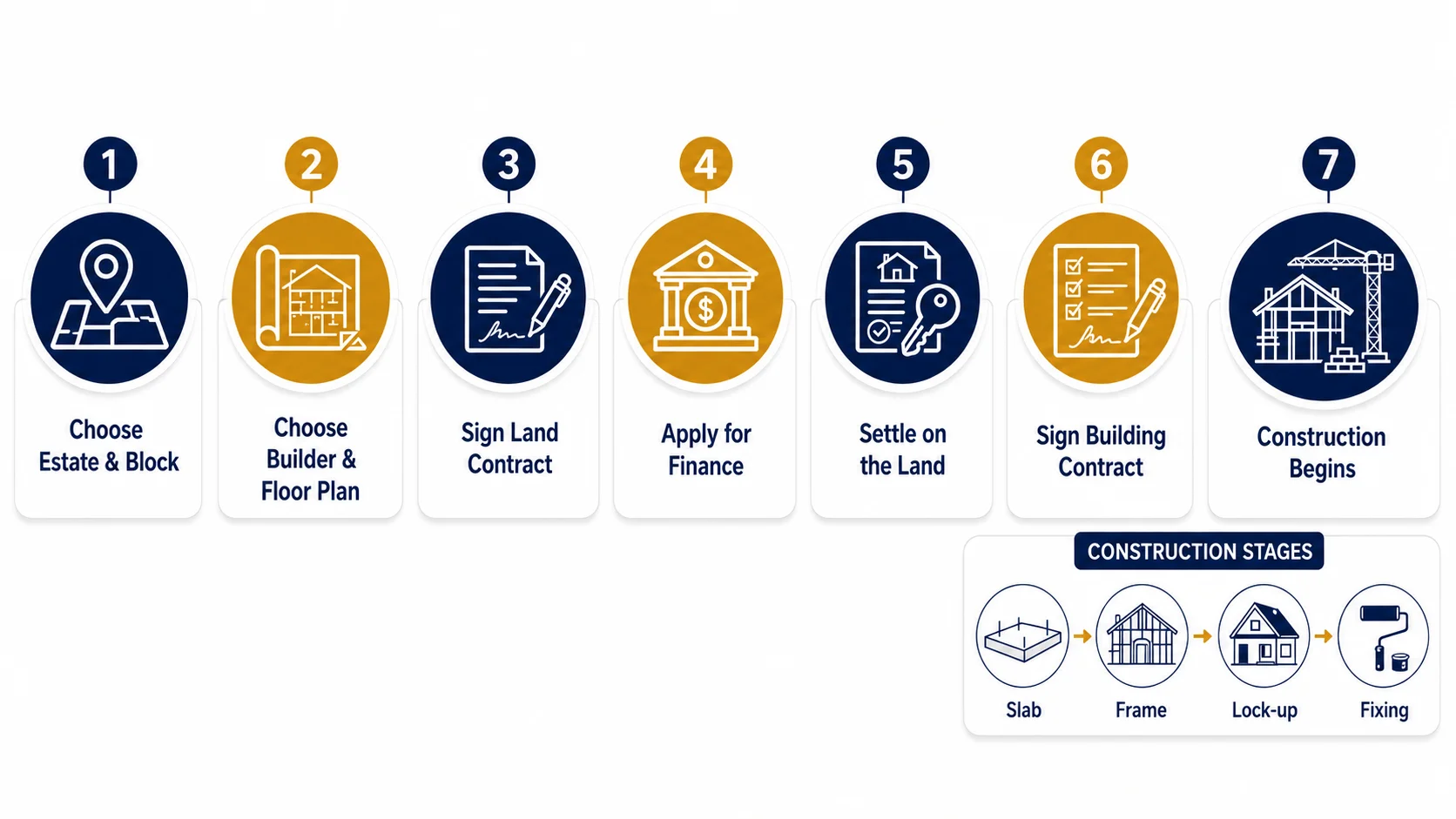
Your lender releases funds at each stage as a progress payment, so you only pay for work that’s actually been done. A final inspection and handover follow completion, then a statutory builder’s warranty kicks in to cover structural and other defects.
Before you sign, confirm your builder holds a current QBCC licence and ask to walk through a near-complete home in the same estate. This small step takes a few minutes and tells you more about build quality than any brochure will.
Standard inclusions typically cover the structural build: walls, roof, a basic kitchen and bathroom fit-out, and floor coverings in main living areas. What’s often missing catches people off guard. Driveways, fencing, landscaping, and window coverings are commonly excluded from a standard package, and these hidden costs are where most buyers get caught out.
Site costs deserve close attention, too. Before you sign, a soil test determines your site classification, which affects footing and slab design. A standard site costs less to build on than a reactive or sloping one. If your block needs retaining walls or extra fill, expect this to add to the final price, even under a fixed price contract. Total package costs can shift once site costs are confirmed, so ask your builder for a site cost cap upfront rather than an open-ended estimate.
The main difference between turnkey and standard house and land packages is that a turnkey package removes most of these unknowns. It includes everything a standard package leaves out: driveway, fencing, landscaping, blinds, and sometimes appliances, so the home is genuinely move-in ready at handover.
Turnkey packages cost more upfront. In return, they remove the post-settlement spending that catches buyers off guard, and they suit investors who want a tenant-ready property without extra outlay after settlement.
If budget certainty matters more to you than a lower headline price, turnkey is worth the premium.
Lenders treat a house and land package as two linked loans: a land loan and a construction loan, often packaged together under one facility.
You’ll need a deposit, a lender valuation, and proof of borrowing capacity before approval. Most lenders ask for 10% to 20% of the total package value as a deposit. Below 20%, lenders’ mortgage insurance usually applies. Budget for legal fees and lender fees on top of this, since neither sits inside the building contract.
Once approved, the construction loan releases funds in stages, matching the slab, frame, lock-up, and fixing milestones. You only pay interest on funds drawn down so far, so repayments start small and grow as the build progresses.
From 1 May 2025, eligible first home buyers pay zero transfer duty on new homes and vacant land in Queensland, with no value cap. That’s a direct saving of several thousand dollars on a typical house and land package.
On top of that, the Queensland First Home Owner Grant offers $30,000 toward new homes valued under $750,000. This increased grant amount was originally set to revert to $15,000 after 30 June 2026, but the Queensland Government has confirmed it will continue at $30,000 for eligible contracts signed from 1 July 2026 onward. Rates and thresholds can still change, so confirm current figures on the Queensland Revenue Office’s transfer duty estimator before you finalise your budget.
Combined, these changes make house and land packages one of the most cost-effective ways to buy in Queensland right now, especially for first-home buyers.
A house and land package suits both, but the priorities differ. First home buyers usually weigh grants, finance, and long-term liveability. Investors look more closely at rental yield, depreciation benefits, and capital growth potential in the surrounding area.
Our guide to property investment cash flow covers the investor numbers, including depreciation and negative gearing, in more depth.
Location drives long-term value as much as the build itself. Brisbane, Logan, Ipswich, and Moreton Bay remain strong growth corridors in South East Queensland, backed by infrastructure spending, new transport links, and established school catchments.
Before committing to a block, check planned infrastructure and rental demand in the suburb, not just the estate. Buyers who do this homework upfront tend to see stronger capital growth and an easier resale down the track.
House and land packages reward buyers who understand the contracts, the inclusions, and the finance structure before they commit. At Landmark Property Group QLD, we work alongside trusted builders and developers across South East Queensland to help first home buyers, owner-occupiers, and investors find a package that matches their budget and goals. Talk to our team before you sign anything.
Often yes, mainly through stamp duty savings and grants on new builds, though land prices in high-demand corridors can offset some of that gap.
Most builds take 8 to 14 months from land settlement to handover, depending on the builder, council approvals, and weather.
First home buyers pay zero transfer duty on new homes and vacant land from 1 May 2025. Other buyers pay duty on the land component only, not the full package price.
A turnkey package includes finishing touches like driveways, fencing, and landscaping. A standard package leaves these for you to add after handover.
Most builders allow upgrades and minor layout changes within the inclusions list. Structural changes usually cost extra and need separate council approval.
Welcome to Landmark Property Group QLD, Where Heritage Meets Luxury
White Rock Dr, White Rock QLD 4306, Australia
Sam@landmarkhomesqld.com.au
+61 499 207 377